FIKA IELTS
Overview
An AI-powered mobile learning app designed to help users prepare for the IELTS exam through real-time feedback and personalized speech simulation. I led the entire product design process—from user research and feature definition to UI/UX design and AI prompt integration. The core innovation was an AI-powered tutor that gives real-time feedback in speaking and writing tasks. We launched it in May 2024 on both the Android and iOS app stores.
Challenge
Traditional IELTS preparation forces students into a binary of prohibitively expensive human tutoring or isolated practice that offers no immediate feedback on performance. We needed to bridge this gap by building a high-fidelity AI environment that provides real-time, rubric-aligned scoring to eliminate the "guessing game" of self-study.
The process
My design approach is iterative and human-centered. I utilize a structured 5-step methodology that moves from deep discovery and synthesis to rapid ideation, refinement, and post-launch reflection to ensure every feature solves a real user pain point.
Research
DESK RESEARCH
COMPETITOR ANALYSIS
Synthesis
USER INTERVIEWS
PERSONAS
POINT OF VIEW
Ideation
LOW FIDELITY
HIGH FIDELITY
USABILITY TESTING
Final Designs
DESIGN SYSTEM
UI FOR LAUNCH
Reflection
POST DESIGNS
POST THOUGHTS
Desk Research
Before initiating the design phase of the product, I started by conducting market research to understand the competitive landscape, target demographics, and market needs. My focus was on the IELTS exam, a test used to measure English proficiency for students, professionals, and immigrants.
I began with the research about market size, the research showed that over 4 million people took the IELTS test worldwide in 2023. In Vietnam (my home country), more than 124,000 certificates were issued in 2022. Additionally, the global e-learning market size reached US$ 316.2 billion in 2023. This data underscores a significant business opportunity, presenting a scalable and profitable market for digital learning solutions.
Then, I researched the IELTS performance of test-takers, particularly in Vietnam. The data revealed that the majority of Vietnamese test-takers (62%) are young individuals aged 16 to 22. Moreover, Vietnamese test-takers tend to perform relatively well in Listening and Reading but face significant challenges in Speaking, with an average score of just 5.7—the lowest among all sections. This highlighted a clear need for a product aimed at improving Speaking skills for young students preparing for academic or career opportunities abroad.
Competitive Analysis
While current market leaders excel at supporting general English fluency or offering static repositories of study materials, they often fail to simulate the high-fidelity, rubric-based environment of the actual IELTS exam. Users are left with a "preparedness gap" where casual conversation with AI doesn't translate to the structured performance required by examiners.
| Platform | Real-Time Feedback | IELTS Band Scoring | Exam Simulation |
|---|---|---|---|
| ELSA Speak | |||
| Praktika | |||
| IELTS Speaking Assistant | |||
| FIKA (Target Product) |
"FIKA fills the gap between casual English conversation apps and static test preparation materials, replacing passive practice with a focused, high-fidelity exam simulation."
User Interview
To validate the initial problem space, I conducted a series of in-depth primary research sessions with a cohort of high-intent IELTS candidates. The goal was to move beyond market trends and uncover the visceral psychological and technical barriers candidates face during their preparation journey.
Research Snapshot
Affinity Mapping Analysis
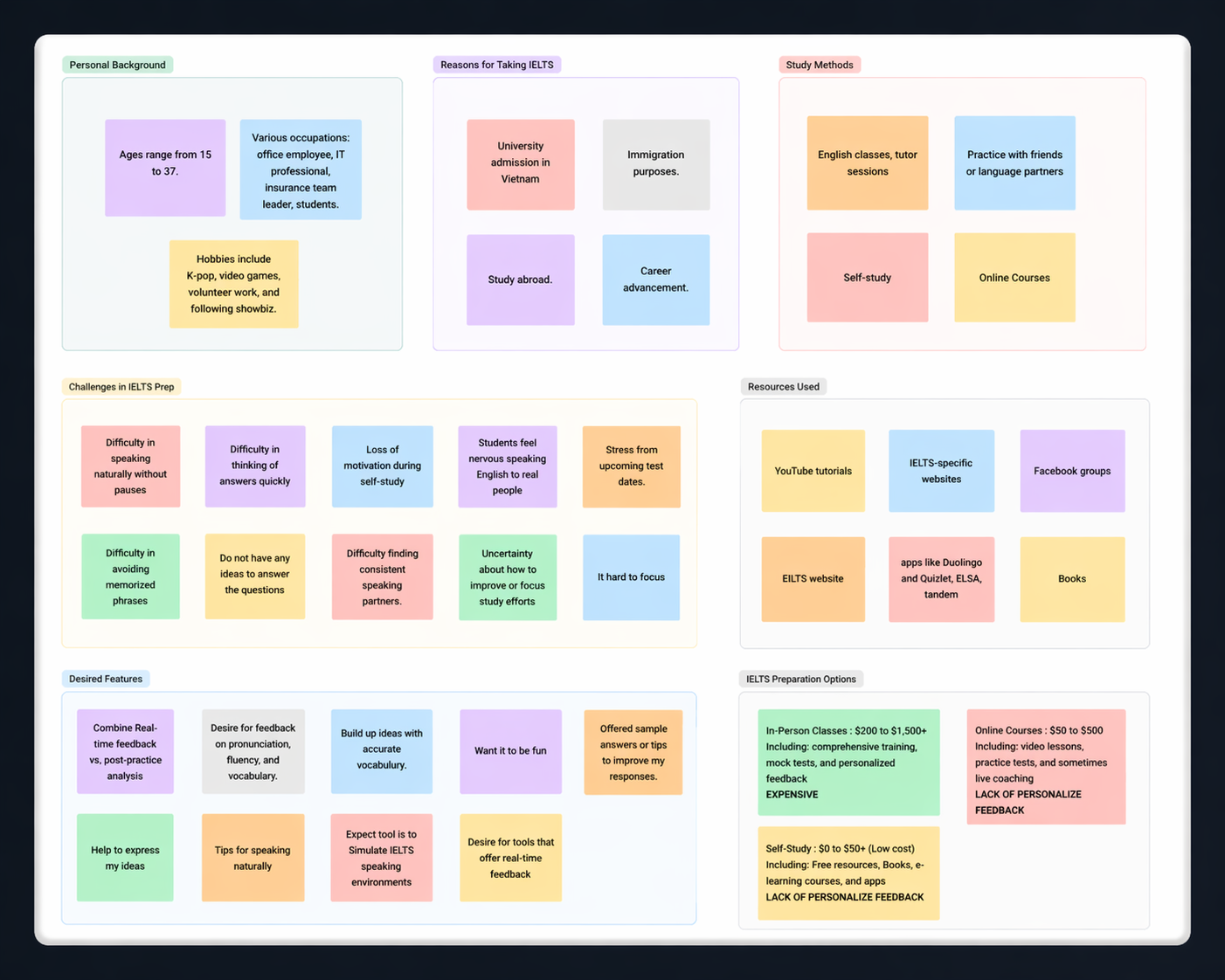
Key Insights
The Validation Void
"I keep recording my voice, but I'm just guessing if it's correct. I'm worried I'm just practicing my mistakes and wasting time."
P1 - UNIVERSITY STUDENT - AIMING FOR BAND 7.0 FOR EXCHANGE
UX Implication
Built a 'Real-time Diagnostic' engine that scores responses against official IELTS rubrics immediately to eliminate unvalidated effort.
Judgment Paralysis
"I feel so nervous talking to real tutors. I'm scared they'll judge my accent or grammar, so I usually just stay quiet and don't speak at all."
P4 - JUNIOR IT PROFESSIONAL - NEEDS 6.5 FOR CAREER GROWTH
UX Implication
Designed an empathetic AI partner that provides non-judgmental feedback, lowering the 'shame barrier' and increasing daily practice time.
The Simulation Gap
"Other apps feel like games, but the real exam is stressful. When I see the timer and it's quiet, I just panic and get stuck. I need to feel the real pressure."
P2 - HIGH SCHOOL STUDENT - FIRST-TIME TEST TAKER
UX Implication
Developed a 'High-Fidelity Exam Mode' that replicates official test timing and environmental constraints to build psychological resilience.
User Persona
This user persona translates complex research into a tangible archetype, bridging the divide between identified market gaps and the resulting product strategy. It specifically addresses critical psychological barriers including the Validation Void and Judgment Paralysis often encountered by high-stakes test takers using traditional fluency tools.

Minh, 19
The Anxious Achiever
"I score high on reading and writing, but when I try to speak in an official setting, I just freeze. General chat apps improve my accent, but they don't fix my exam mistakes."
User Profile
Narrative Bio
Minh is a dedicated student in Hanoi aiming for a Band 7.5 to secure a full scholarship abroad. He is a frequent user of apps like ELSA for pronunciation and Praktika for casual chat, but he feels frustrated that these tools are too 'casual'. They fail to replicate the formal pressure and strict rubric required to succeed in a real IELTS Speaking interview.
Frustrations
- Fear of "Fossilizing" Mistakes: Practicing alone without real-time correction makes him worry he's turning grammar errors into permanent habits (The Validation Void).
- Safety Barrier: High social anxiety prevents him from practicing with human tutors, resulting in a 'safety gap' that stalls his progress.
- The Context Gap: He can handle gamified chats, but formal silence and strict time constraints in official mock tests cause him to panic.
Core Needs
- Objective Validation: Needs instant, rubric-based scoring (Grammar, Vocab, Fluency) to turn self-study into a data-backed loop.
- Non-Judgmental Haven: Needs an empathetic AI environment to lower his affective filter and build confidence before talking to humans.
- Stress Inoculation: Needs a high-fidelity simulator that enforces official test timing to build psychological resilience.
Design Challenges
To bridge the gap between user frustrations and the product roadmap, I reframed the core research insights into three strategic Design Challenges. These questions directed the ideation phase toward solving high-impact psychological and technical barriers.
Candidates practice in a vacuum, often unaware of whether they are improving or cementing their errors.
How might we leverage AI to provide instant, rubric-based validation that mirrors a human examiner's critique?
Fear of judgment and social anxiety often paralyze learners when faced with human tutors or partners.
How might we design a conversational interface that feels safe enough to encourage daily vocal risk-taking?
Casual learning tools fail to replicate the rigid timing and environmental pressure of the official IELTS setting.
How might we immerse candidates in a high-fidelity exam simulation to build the mental resilience required for test day?
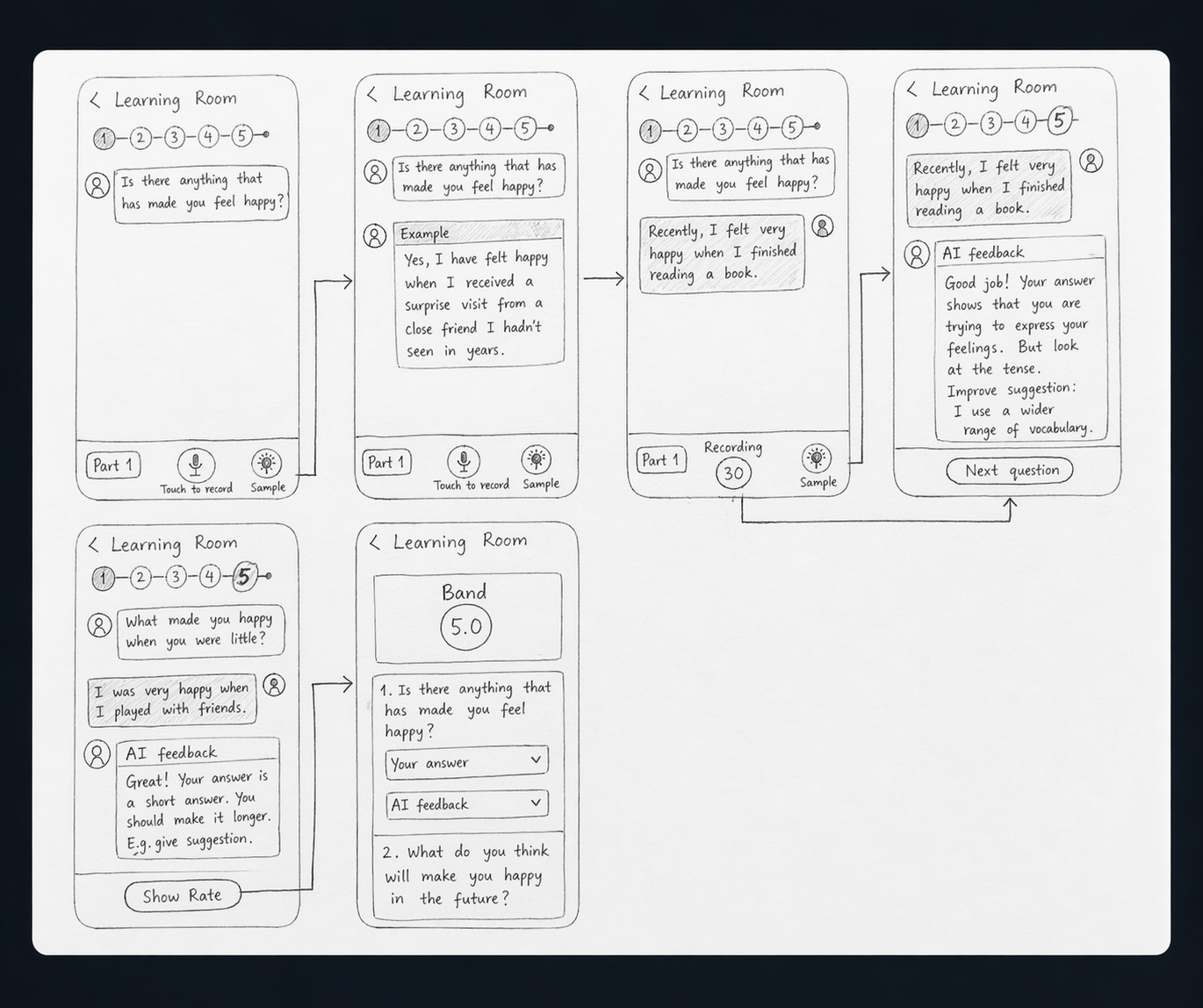
Paper Wireframe
I started on paper to deconstruct the 'Exam Fear'. By sketching a Conversational UI, I aimed to transform the experience from a stressful test into a casual chat. This approach ensures AI feedback is received as supportive guidance, fostering a safe environment for trial and error.
Low-Fidelity Prototype
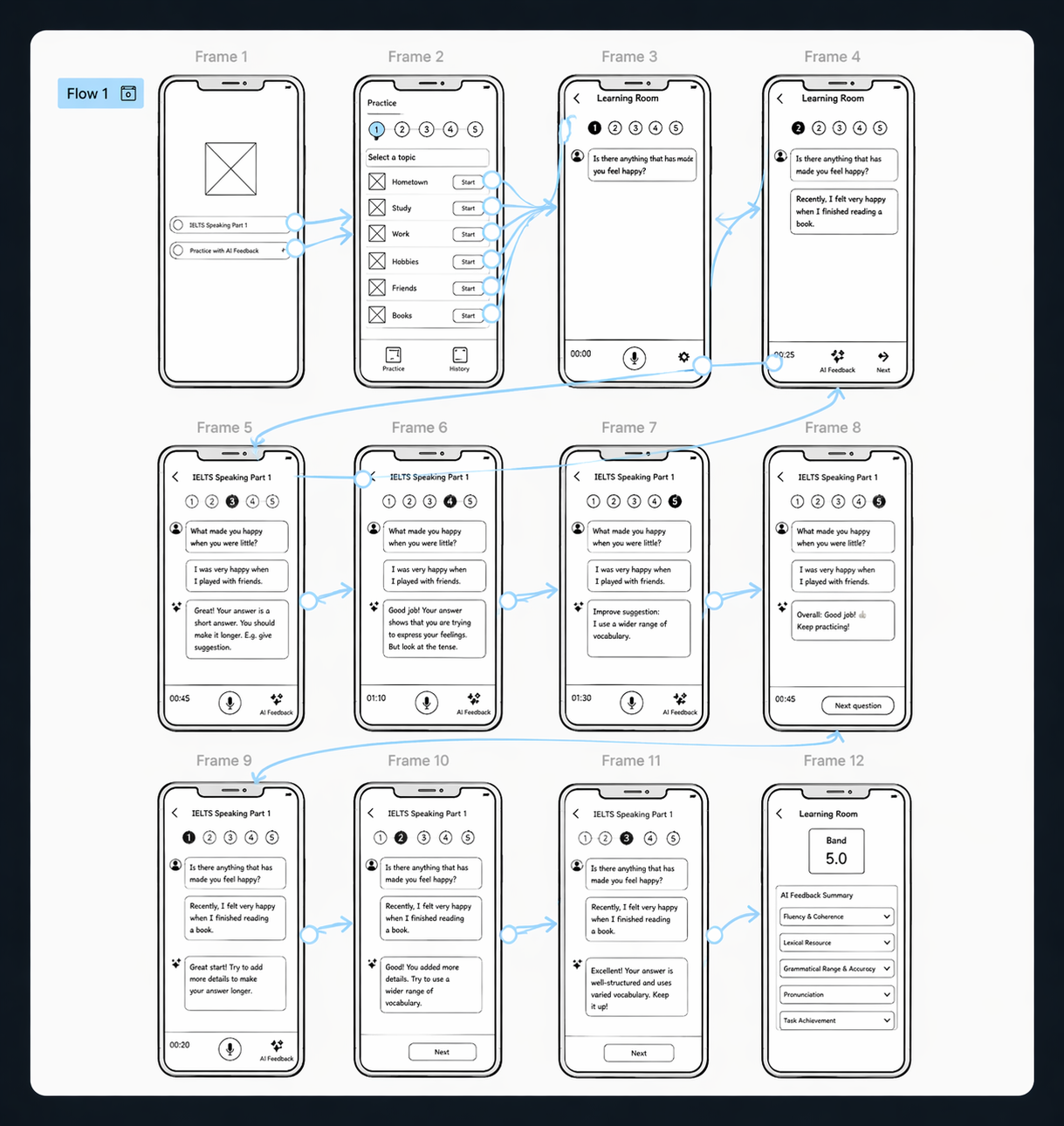
Transitioning from sketches to digital lo-fi, I focused on testing the core 'Speaking Loop'. The goal was to verify if the Chat Interface was intuitive enough for users to record their voice and understand the AI's instant feedback without needing an onboarding tutorial. This stage allowed me to catch navigation errors early before committing to high-fidelity UI.
Usability Validation
To transition from concept to high-fidelity, I conducted remote moderated usability testing via Google Meet with 5 high-intent candidates (Band 5.5 - 7.0). The primary task was a full IELTS Speaking Part 1 simulation to observe their psychological response to the AI tutor.
Error Recovery Issues
Users experienced significant 'Fatal Mistake' anxiety. Lacking a way to fix minor slips immediately led to friction, highlighting that the initial flow was too rigid for an educational environment.
The Immersion Gap
The voice-only interface triggered the 'Ghost Effect'. Without a visual anchor or "face" to interact with, users felt the simulation lacked the healthy pressure required for test-day readiness.
68/100
SUS Score (Marginal)Users completed the task but struggled with confidence and error recovery.
"I wanted to retry, but I felt stuck in the flow. It made me more nervous than the real exam."
— PARTICIPANT #3Allowing users retry the question
Users expressed the need to retry questions to improve their responses.
I added the "Try Again (3)" option, enabling users to attempt the question multiple times. This feature helps users enhance their responses by incorporating the feedback provided.
Simulating a face-to-face testing environment
Users find that voice only conversation unengaging and unrealistic for practicing speaking.
In the revised version, the video conversations simulate face-to-face interactions, aligning the practice environment with real-world scenarios.
UI for Launch
My ultimate goal for the high-fidelity UI was to dismantle the anxiety uncovered during research. Knowing that users felt trapped in a 'Validation Void', I designed the feedback system to be encouraging and transparent, turning intimidating metrics into a clear roadmap for improvement. Every visual choice, from the clean typography to the calming whitespace, was deliberate in countering 'Judgment Paralysis.' The interface steps back to let the user focus, creating a psychological safety net where they finally feel free to speak up and learn from their mistakes.
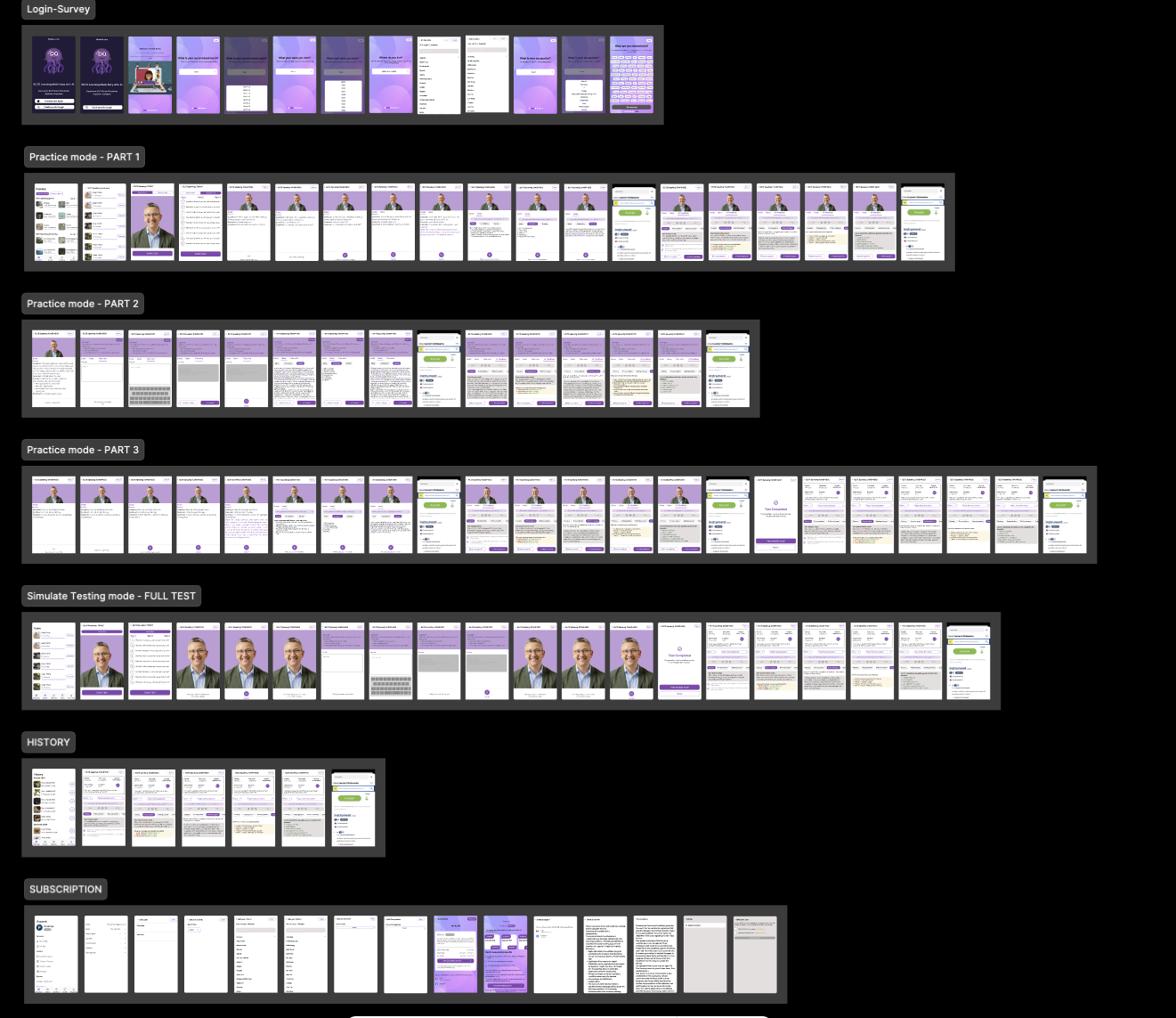 Final App Mockups
Post Designs Outcome
Market Validation
Total download without any marketing campaigns: Over 10,000 users (Dec 2024)
App Rating: 4.8 star
Organic Positive User Feedback: Over 100 feedbacks.
Product Development
Public Launch on Apple and Google Play Store (21 May 2024)
My Key Takeaways
This project taught me how to design with AI in mind—from crafting prompt workflows to managing user expectations. It also strengthened my ability to balance technical constraints with user needs in a startup environment where speed and clarity are key.